 | ||
|
| ||
Worms and Leprechauns
By L. A. Rotheraine"There is no coincidence that the words human and humus are related and the Bible reminds us that from dust we came and to dust we shall return..."
--Wolf D. Storl, Culture and Horticulture
The end of the last glacial period marked the final destruction of Atlantis. This was about 12,000 years ago and is called the Great Flood in the Bible, which skips the Atlantean period other than the story of Noah.
One place that survived the Flood is the island now called Ireland. There, some of the ancients were trained to work in the spiritual world alongside their earth existence. These selected individuals became experts in how the spiritual world creates life on earth--thus masters of science and agriculture.
They knew that there are categories of spiritual beings that work on plants, now designated humorously as leprechauns. Other ancient cultures called them by other names--the most common being gnomes (root spirits).
In a lecture on the plant world given by Dr. Rudolf Steiner in Dornach on November 2, 1923, he said the following about gnomes / leprechauns:
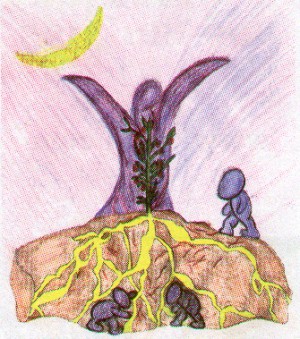 Drawing by George Cabisca |
We look out into the wide world. The world has been built in the spirit of the universe; it is an embodiment of the ideas of the universe, of the spirit of the universe. Through the plants. which to them are what rays of light are to us, the gnomes take in the ideas of the universe and carry them in full consciousness from metal to metal, from rock to rock within the earth.
We gaze down into the depths of the earth, not to seek there below abstract ideas about mechanical laws of nature but to behold the roving wandering gnomes which are the light-filled preservers of the world intellect within the earth."
One of the gnomes main functions, Steiner says, is to act as the head (spiritual head organ) for the worm and other creatures that don't have a real head.
In observing an earthworm you can see it as basically an intestinal tract. The life force that motivates it is the gnome! leprechaun--which is the intelligence behind the worm's creative activity. From the spiritual life sphere--also called the etheric sphere by Steiner and his student Ehrenfried Pfeiffer(1) the gnome causes the worm to give to the earth precisely as much etheric force (life force) as it needs for plant growth.
In his book Soil, Grass and Cancer the French scientist Andre Voisin begins to solve the mystery of the similarity in the words human and humus when he shows earthworms as the foundation of all civilization. The earthworm is a prime builder of humus and without humus neither humans nor plants and animals could survive in physical form.
According to Tompkins and Bird (2) In ancient Egypt the worm was considered a sacred animal. Farmers were quite conscious of the worm being the key to fertile soil, and Cleopatra ordered Egyptians to protect and nurture them. A USDA agricultural report on investigations carried out in the valley of the Nile in 1949, before the Aswan Dam, indicated that the great fertility of the soil was due largely to the work of earthworms. It was estimated that during the six months of active growing season each year the castings of earthworms on these soils amounted to a stunning 120 tons per acre, and in each handful of that soil there are more microorganisms than there are humans on the planet.
Night crawlers feed on leaves, which they drag down into their burrows and even with their pinhead brains they have the wit to pull them by the narrow end-- which shows more wit than the leaf gathering suburbanite who spends a fortune (trashing leaves) to deprive the earthworm of his autumnal fare.
The pinhead brain as Tomkins and Bird describe it, could never show the wit ascribed to it--the leprechauns are the wit of the worm.
This article originally appeared in LILIPOH (Fall/Winter 1999 pp. 24)
Bibliography
(1) Ehrenfried Pfeiffer (1902 to 1962) Pioneer of the biodynamic method of farming and gardening
(2) Secrets of the Soil - Tomkins and Bird - pp. 41 and 45
L.A. Rotheraine is a writer, lecturer and award-winning biodynamic gardener in Bradford, PA.
Copyright 2004 L.A. Rotheraine
First printed in Lilipoh