 | ||
|
| ||
Sludge to Fertile Soil!An Amazing Answer To A $64,000 |
Adapted from an article by Grant Nichols in the Bradford Journal & Miner Vol.CLVII No.29 by Christine Murphy and published in Lilipoh.
In May of 1996 the Bradford City Water Authority, of Bradford, PA, with a special waiver from the Department of Environmental Protection (DEP), embarked on an unique sludge conversion project. As in all closed-loop water filtration systems the biggest problem is how to dispose of sludge (a phosphorus poor by-product with low levels of organic materials). For many years the disposal procedure of choice has been to compress the material and deposit it in a landfill.
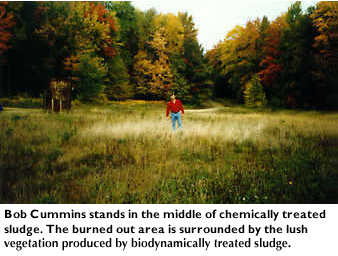
The new project however considered revitalizing the sludge and converting it to soil. The first step was depositing the sludge at a stone quarry on the Bradford Watershed. Next, seeding and fertilizing was done using two different methods. A 24'x24' area was planted with commercial seeding and chemical fertilizing techniques. The balance of the area of approximately 1-1/2 acres, was treated with biodynamic methods only. According to Kim Benjamin, water utility manager, the area cultivated using biodynamic techniques is now healthy and strong while the chemically fertilized area is thin and burned out (see photo).
 |
 Bob Cummins with a biodynamic cabbage given him by biodynamic gardener LA Rotheraine. Bob Cummins with a biodynamic cabbage given him by biodynamic gardener LA Rotheraine. |
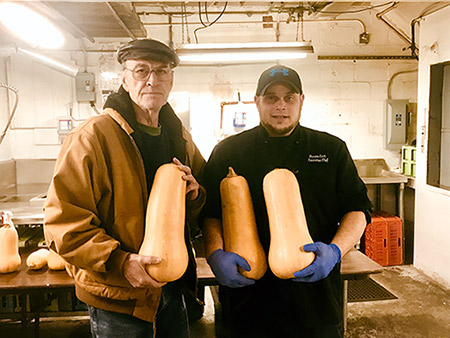 L.A. Rotheraine, Biodynamic Master Gardener with Jordan Evan, Executive Chef at the Penn Hills Club, show Biodynamic Butternut Squash. |
|
L.A. Rotheraine*, agronomist for the project, proved that sludge can be fully reclaimed and revitalized and that biodynamic methods are the most effective and practical solution to sludge disposal. It is also the cheapest. Had the sludge been handled in conventional ways, it would have cost taxpayers $64,000 more to get the job done!
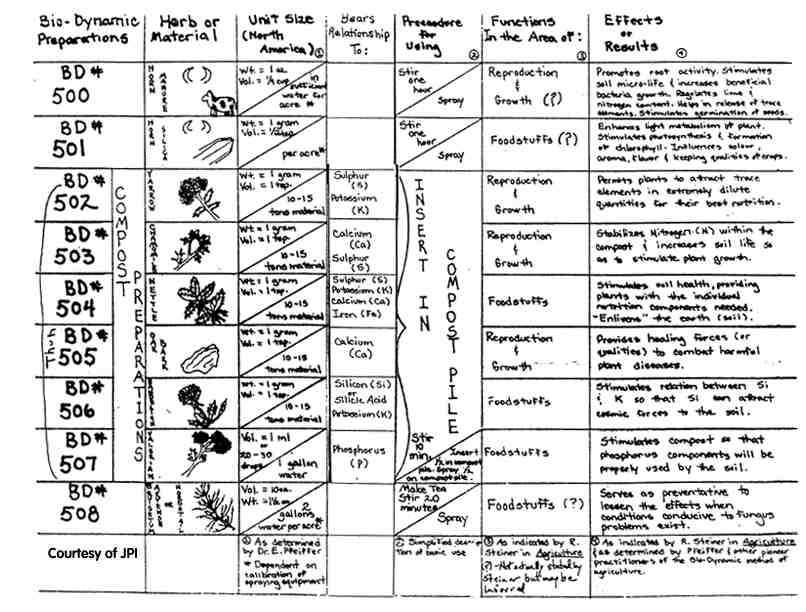
Rotheraine's calculations depended on laying seeds (five types of grass, plus winter wheat, winter rye and oats) on top of the fresh sludge and covering them with approximately 2-4 inches of hay. He activated the seeds with a life-enhancing biodynamic preparation (#500 horn manure - see Lilipoh "Nutrition and the Land") which he sprayed over the hay.
The solution was combined with Thun Barrel Compost for instant nutrition. This latter consists of six biodynamic preparations: yarrow, chamomile, stinging nettle, oak bark, dandelion flowers, juice of valerian flowers, with basalt, cow manure and pulverized egg shells. (See BD Prep Chart.)
During the course of the summer the sludge was sprayed three or four more times with the Thun Barrel Compost by Bob Cummins of the Cummins Construction Company and Rotheraine. A delighted Cummins --the contractor for the Water Authority--when asked if he had any doubts about the success of the project, said, "As soon as Evergreen Elm lent us Rotheraine to mastermind the job, I knew we would succeed." Today, one year later, the biodynamically treated area is unbelievably fertile; far healthier than a comparable regular environment.
*Footnote:
This past summer's McKean County Fair in Northwestern Pennsylvania saw the Evergreen Elm gardening group shine again. They won 26 blue ribbons out of 30 entries for their biodynamically-grown produce. Evergreen Elm's master gardener L.A. Rotheraine, speaking as a private citizen, says, "This is renewed proof that biodynamic methods, freely available to those who wish to make use of them, outperform in quality, yield, taste and nutritional content the methods foisted on us by chemical companies and the agricultural schools that have become their tools.
Until the schools of agriculture learn that plants are microcosms of the stars and planets, the erroneous concept of plant growth that they teach makes their produce inferior. This forces the use of chemical fertilizers to compensate for their child-like approach to agriculture, thereby destroying our precious germ stock, while producing synthetic, tasteless vegetables having questionable nutritional value. Even the most retrograde of ancient cultures knew the correlations between earthly life and heavenly life."
Copyright 2004 L.A. Rotheraine